Rotator boxes are great for heavy bulk handling because they allow for seamless material transfer without the risks associated with manual labor. While rotator boxes can save time, improve process efficiency, and keep workers safe, you’ll only get the maximum benefits if they’re designed for your application.
These boxes can be used for anything from dumping bulk agricultural products into hoppers for later processing to disposing of rusty scrap metal after sorting. Before you buy a new rotator box, ask yourself these questions:
How Much Material Will You Handle?
Rotator boxes can handle thousands of pounds, depending on their design and the tilt they can accommodate. The use of heavy-gauge steel is essential when you want to push the loads up above 4,000 or 5,000 lbs. Dense materials like gravel and lead ballast are rough on containers, exerting extra force against the sides and bottom during loading and unloading. Knowing the average weights and densities of the materials you plan to handle with the rotator boxes allows for extra reinforcement to prevent early failure.
What Type of Material Will You Handle?
In addition to the material’s weight and density, you need to consider how it flows, based on particle shape, viscosity, and moisture levels. Rubber balls will easily roll out of a tipped container at a low tilt level, while fine powders that cling to themselves may require a full 360-degree rotation for complete emptying. Knowing the desired rotation or tilt angle also informs the size and gauge of steel required for the design.
How Is the Material Stored?
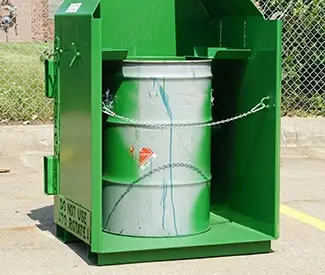
Rotator boxes can secure and retain a wide variety of containers for unloading, including 55- or 110-gallon drums, bulk metal or wood crates, Gaylord boxes, and more. The size and shape of the storage container affect loading and help determine which side it must sit on before tilting.
Are You Operating in a Harsh Environment?
Many manufacturing and recycling environments are corrosive, which shortens the lifespan of certain metal equipment. Rotator boxes can be designed to handle wet, acidic, or rusty materials without being affected by corrosion. Additionally, rotator boxes can feature durable coatings or be constructed from stainless steel to meet strict food and pharmaceutical processing requirements.
Where Is the Material Being Disposed?
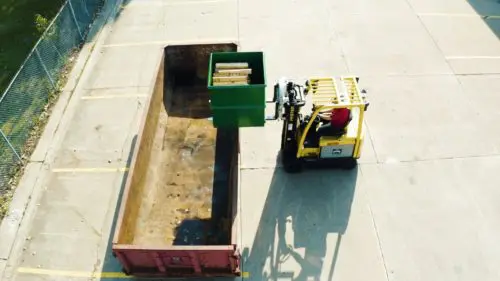
The disposal area, whether an open container, a small chute, or a high-sided hopper, largely affects the angle of tilt or rotation needed, as well as the ideal shape and size of the top opening of the rotator box. The goal of a custom design is to ensure materials flow smoothly into the disposal area with minimal bounce or drop-out.
Is Carry-Back Acceptable?
Carry-back refers to the residues left behind between batches of material dumped out of the rotator box. For many disposal and scrap sorting uses, a few bits of rubber or fabric lingering in the corners of the container won’t affect the overall workflow or safety procedures. However, in food and pharmaceutical applications, carry-back is unacceptable due to the risks of contamination and bacterial growth.
What Are Your Space Limitations?
Rotator boxes are smaller than other types of material handling equipment. However, they still need adequate overhead clearance as they’re lifted on the forklift. If you have limited clearance in the area where you plan to dump materials, the rotator box height can be adjusted to fit tighter spaces.
Get Help Designing Your Custom Rotator Box
Roura Material Handling specializes in manufacturing material handling equipment, including self-dumping hoppers, bottom drop boxes, and rotator boxes. All of our equipment is designed for easy compatibility with forklifts; our rotator boxes feature four-way entry as standard, so that operators can approach the box from any side.
Our boxes are available in capacities ranging from 1/2 cubic yard to 3 cubic yards and up to 6,000 lbs, and are entirely customized for your application. We regularly engineer rotator boxes for farms, recycling facilities, packaging and processing facilities, and manufacturing applications.
Visit our website to learn more about our options, or to use our chatbot for instant product recommendations based on the material you’re handling and intended application. If you need help designing a custom rotator box, please contact a team member at (586) 315-1949.