Stone, whether aggregate, marble, granite, or even concrete debris, is heavy, dirty, sometimes wet, and always awkward to handle.
Hoppers are the answer to easier and safer stone handling. However, not all hoppers are made the same. If you tip a slab into a hopper not designed for stone handling, you risk failing casters, structural deformation, surface wear, corrosion from moisture, and even damage to the slab itself.
Roura Material Handling specializes in custom manufacturing hoppers for various industry applications, including stone handling.
If you’re in the market for a hopper, here is what we would recommend you focus on when customizing your hopper design:
Construction & Load Requirements
Stone products are dense and can easily overload lighter hopper constructions. Evaluate the weight limit and volumetric capacity for your application, and find a hopper that can reliably handle that load.
The hopper should be constructed from heavy-gauge steel to maximize its lifespan and resist abrasion, and feature reinforced sides to prevent flexing or bulging.
Design

How often are your stone products wet? If often, you will want to specify a hopper that drains for safer, easier handling. Another feature to consider is open sides, which can simplify loading and filling for some large slab materials.
Compatibility With Handling Equipment
Stone hoppers should always be selected to suit the type of forklifts you operate. Fork pockets ensure stable lifting and keep the load secure as it is moved to a bag filler, dumpster, or other unloading point.
How the stone will be dumped helps determine the type of release system needed. For forward-dumping hoppers, Roura’s standard is the mechanical release, which is designed for use with forklifts. An alternative is the pull-down, which is used when stone will be dumped from elevated heights.
Safety Features (Latches, Bases, & More)
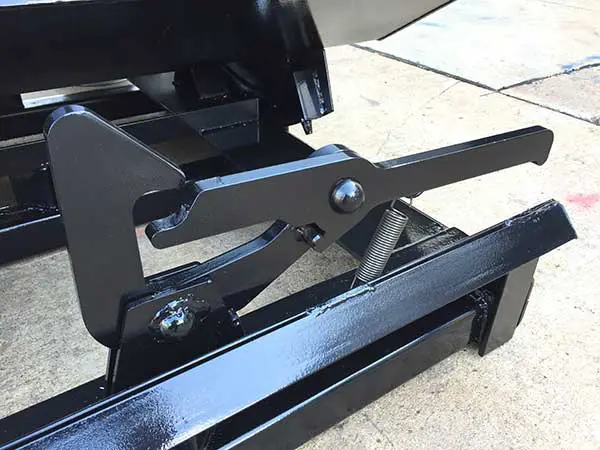
The latch guard and trip latch systems are important for preventing unintended material release.
Bases also impact the stability of the hopper. We recommend an open-channel design for a smaller-capacity hopper and a boxed tube design for heavy load applications. Other base options, including three-way fork entry bases, base legs (for raising the hopper), or modified fork pocket dimensions, can improve ease of use and safety, depending on the application.
Other safety features to consider are additional reinforcements and high-visibility painting. The former increases strength and load-carrying capacity, while the latter helps prevent accidents, especially when hoppers are placed in poorly lit factory yards.
Portability (Casters/Wheels)
While dedicated stone handling products, including slab racks and A-frames, are ideal for long-term storage, some applications require portability without a forklift, such as restricted-access areas at the end of a crushing, cutting, or walking line.
Standard hoppers do not come with casters, but they can be added based on portability needs. Ductile iron and semi-steel wheels are widely used for stone handling because of their strength, but polyurethane, phenolic, polyolefin, and rubber varieties are also available, depending on the floor type. For added versatility, Roura offers removable casters that attach via heavy-gauge removal caster pads, so hoppers can be moved around manually or with a forklift as needed.
Added Protection (Lining & Lids)

Stone is abrasive and can generate hazardous dust, so we always recommend interior linings for added durability and lids for added protection.
A lining protects the hopper’s interior from abrasive wear; linings can be made from polyethylene, rubber, or steel. Steel has the best abrasion resistance among these three options, but rubber reduces noise when materials are dropped in, and polyethylene lasts longer in wet or corrosive environments.
A lid can help minimize airborne pollution for workers and, if hoppers are stored outdoors, prevent water from entering the hopper. We offer metal and plastic lids. Our metal lids can be designed to open at the front or at both front and back. We can also customize stone hopper lids with additional reinforcement if needed, or make the lid removable.
Customize Your Hopper
Roura Material Handling has been the industry leader for self-dumping hoppers since our inception in 1915. Whether you’re transporting stone remnants after a demolition or storing fabricated slabs, you can trust our team to engineer and manufacture durable hoppers that make handling easier, safer, and more efficient for your team.
Visit our website to browse some of our standard models, or call (586) 790-6100 to start customizing your stone hopper.