Bulk material spills take time to clean up, but they can’t be ignored. They make the workplace untidy and, more importantly, cause accidents and environmental issues that can attract the attention of the EPA.
Using rotator boxes will help prevent these problems. In manufacturing plants, rotator boxes are used to collect and store scrap, which is then removed by a forklift and dumped into a dumpster. They’re also used for emptying drums, and are especially useful for tipping out large and awkward Gaylord boxes.
Although rotator boxes can help prevent accidents, improve workplace organization, and increase productivity, you still need to select the right design for your current and future needs. This Buyers’ Guide will help you make the right choice.
Needed Capacity
Capacity refers to both weight and volume, but the one that matters the most depends on what materials you’ll be lifting and turning.
In terms of weight, rotator boxes are available in models that can effectively handle up to 6,500 pounds. However, do you need that much, and would a lighter-duty box be more sufficient? If you’re lifting bulk aggregate, then yes, perhaps a heavy-duty box is the better solution, but if you’re handling foam off-cuts, a lighter-duty rotator will do the job just fine.
Beyond weight, you’ll want to consider volume when storing and moving light materials, such as foam. Rotator boxes are available in capacities from ½ cubic yard up to 3 cubic yards. Decide what’s right for your operation, given that your goal (or at least one of your goals) is to minimize how often you need to make trips to your dumpster or trailer.
Materials Being Handled
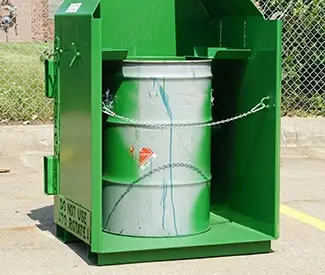
Rotator boxes don’t just come in square/cubic shapes. There are also specialized designs for materials like bulk wood chips, drum rotators for metal storage drums, and Gaylord rotators designed specifically for holding those pallet-mounted cardboard boxes. Another variation is the lidded rotator bin. If the bin is outdoors, the lid will keep water out and the contents dry. Plus, it can prevent loose materials from being blown away. And if none of the available designs seem quite right, a custom rotator box is always an option.
Rotation Needs
Is 90° enough? Will a 180° rotation be needed to ensure complete emptying? Is there a reason for choosing 360° rotation?
The amount of rotation needed affects both rotator box design (the location of the forklift points, in particular) and how the rotation attachment on the forklift is used. When buying rotator boxes, always consider how they will be raised and emptied, as that will affect both the design and your working practices.
Space Limitations
Regular rotator boxes have a square footprint, typically 39” x 39” or larger, and their height varies depending on the required capacity. Gaylord rotator boxes are, of course, large enough to take a Gayload box on its pallet, and likewise, drum rotators are big enough for 55-gallon barrels.
When choosing a rotator box, don’t focus solely on the footprint. Also consider forklift access.
Some boxes have fork entry points on all sides, while others have them only on opposite ends, which can complicate lifting and moving. Decide where a box will go and how it will be accessed before placing an order.
Compatibility With Existing Equipment
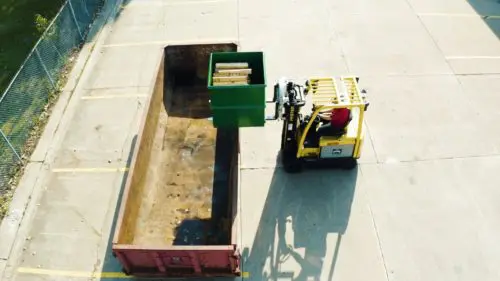
The rotator box or boxes you buy need to work with your existing equipment, including your forklift and the trailer or dumpster you’ll be emptying the box into.
The forklift will need a rotating attachment to rotate the box for emptying. If using a drum rotator, you will also need a drum attachment for your lift.
Once the forklift has picked up the box, it needs to hold it over the dumpster or trailer for rotation and emptying. Check that your truck has the reach needed to empty into the equipment you’ll be using, at the location where you’ll be using it.
Visibility Needs
The default color for Roura’s rotator boxes is green, but other colors are available. Factories may prefer yellow, red, blue, or green to easily identify a safety equipment storage area, but in many outdoor applications, green or brown might be preferred because they don’t stand out at a distance.
Talk to an Expert
Roura’s extensive range of rotator boxes is engineered to suit a wide variety of applications. If this is your first time buying rotator boxes and you’d like some advice, contact us today to speak with one of our product specialists.