Stone slabs aren’t just difficult to store and handle—they can also pose a safety hazard to your team members if they’re not managed correctly.
The right stone handling solutions help you move and display slabs when needed while also providing safe, long-term storage. There are two primary types of handling equipment for stones: A-frames and racks. Both types work well in different situations, so it’s likely your warehouse or shop will need a combination of both.
Let’s take a closer look.
A-Frames

Made from strong tubular steel, A-Frames hold a few dozen slabs at once while taking up relatively little space. Slabs are vertically stacked but separated by the A-shaped part of the frame that gives it its distinct name. Customers can easily walk around the slab and examine it from all angles, and this factor alone can make or break a sale.
There’s still a risk of shifting, so for safety, most A-frames pair with ratchet straps and wood blocking to prevent movement. The right A-frames are safe to use on the showroom floor without posing a trip or crushing hazard. Rolling A-frame racks also work great for transport, allowing the rack to roll into place for viewing wherever the slabs are needed.
Advantages
- Displays the slabs so they’re easily examined by customers and workers alike
- Works well with other safety measures, like strapping and blocking, to prevent tipping
- Streamlines both transport and display without the need to switch from a storage rack to a display unit
- Maximizes storage space in crowded showrooms or warehouses with vertical orientation
- Prevents damage to the edges of slabs
Limitations
- Can still pose a safety risk, especially in the fall shadow area, where a slab can shift
- Holds a limited number of slabs, making it less useful for long-term organization of slabs and remnants
- Higher cost per stored number of slabs than other rack designs
- Must be loaded and unloaded in order
Best Use Cases
- Transferring slabs between the cutting and polishing stages during fabrication
- Organizing and storing slabs for short-term and medium-term periods
- Transporting slabs to the installation site without damage
- Providing customer viewing opportunities in a retail environment
Slab Racks
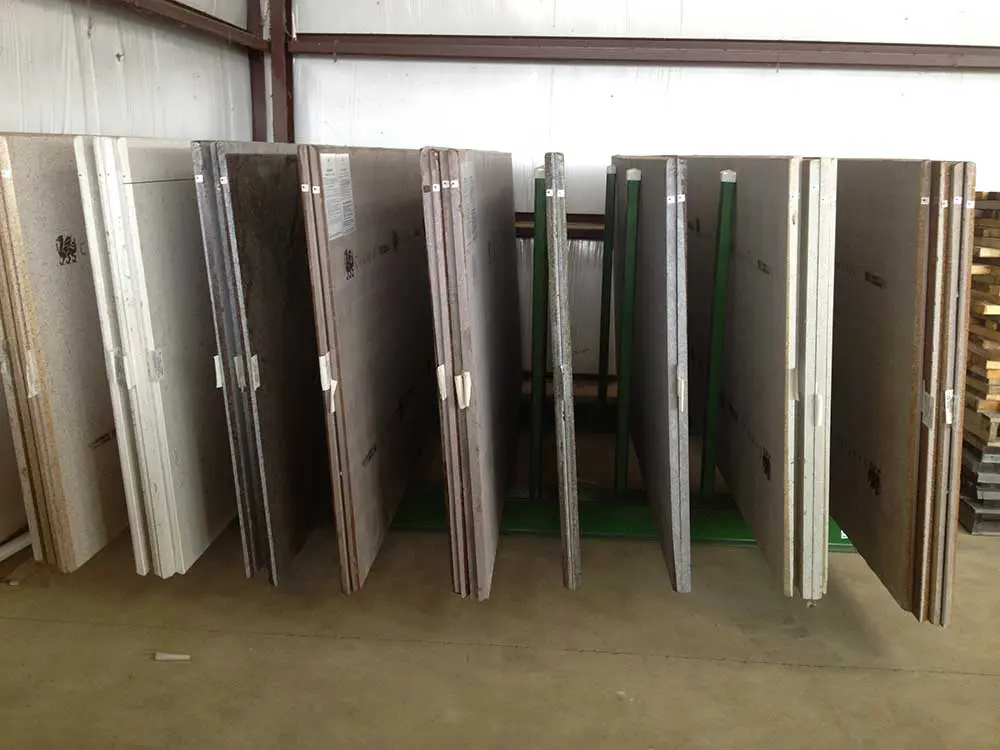
Built to stay in one place rather than roll on heavy-duty casters, slab racks are perfect for keeping your storage areas organized. They provide the best balance of affordability, storage density, and durability for busy fabricators. These racks can hold up to 40 slabs per side, making the most of every square foot of your warehouse space without putting any workers at risk. They generally take the form of an all-steel rack with a heavy base beam supporting vertical posts welded on to keep the heavy slabs from moving.
Advantages
- Affordable and available in a wide variety of post heights, spacing, and weight capacities
- Allows for easy removal of specific slabs needed at the time
- Can be fitted with rubber or EVA sleeves to keep edge chipping from occurring
- Optimizes space and reduces the footprint of racking by 30% or more compared to A-frames
- Minimizes tipping risks in busy working environments
Limitations
- Not as well-suited to displaying slabs to customers
- Stacks are harder to visually assess at a glance
- Not easily moved like rolling A-frame racks
- Higher chance of edge chipping unless fitted with protected sleeves
Best Use Cases
- Warehouse use between fabrication stages or for long-term storage
- Outdoor displays where volume is more important than visibility
- Grouping large orders for specific clients or retailers
Remnant Racks
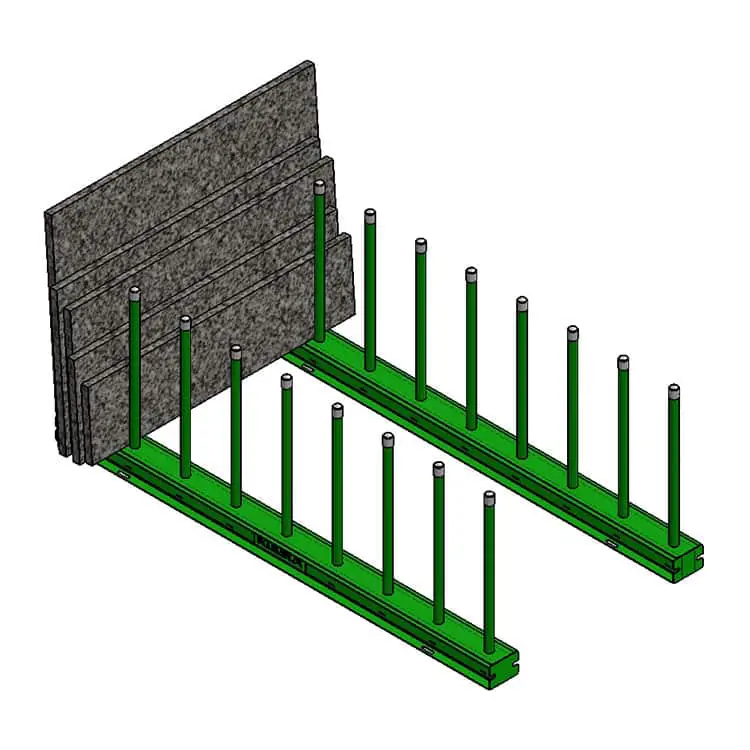
When slabs are cut, the remnants are still valuable enough to reserve for use in smaller projects. However, remnants are harder to store because they no longer feature standardized measurements that allow them to fit into standard racks or frames. Remnant racks feature tighter spacing between the vertical posts and are often adjustable to help you safely secure partial slabs that still weigh hundreds of pounds. They tend to be much shorter than standard slab racks and may sit closer together to keep their balance.
Advantages
- Adjustable or designed to hold odd-shaped slab remnants
- Often paired with tips or caps to keep the posts from scratching the slabs during handling
- Slide-in posts are easily removed when necessary to make space for a different shape
Limitations
- Not as useful for displaying remnants as A-frames
- Requires a little extra safety consideration due to the adjustable design and lower weight limit
Best Use Cases
Storing remnants and partial slabs, whether in the warehouse area or in the showroom for immediate sale
Find Your Solution at Roura
Whether you choose A-Frames or racks for your stone fabrication business, Roura can supply the stone handling equipment you need to improve efficiency and safety. We have over 100 years of experience engineering innovative stone handling equipment, as well as forklift hoppers for a variety of applications.
Visit our website to view our stone products, or contact our experts today if you need help selecting the best solution for your shop.