Rotator boxes and self-dumping hoppers can make material handling more efficient by removing the risks and time associated with manual labor and reducing material waste during transfer. However, each has different features. Understanding the differences between these two, including which applications they perform best in, will help you make the most cost-effective decision.
Do You Need Controlled Discharge?
A fixed rotator box offers more control over the speed and timing of material discharge than a self-dumping hopper. While self-dumping hoppers are controlled by release mechanisms, material will empty as the hopper tilts forward. The rotator box won’t release anything until the forklift operator engages the rotation, allowing a slow, smooth discharge of powdery or fine materials without spilling.
Does the Operator Need to Stay in the Vehicle?
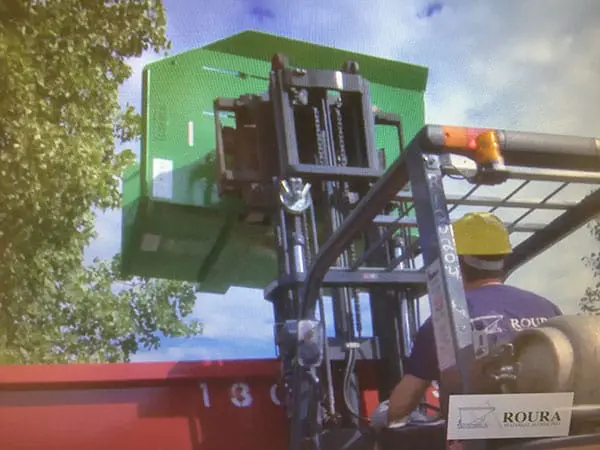
Both rotator boxes and self-dumping hoppers minimize manual labor by relying on forklifts for lifting, transferring, and tilting. However, self-dumping hoppers have the added advantage of providing more volume and heavy load capacity, as well as not requiring a rotating forklift.
Depending on your workflows, this could save hours over the course of a full day, boosting productivity and reducing manual labor for your team. It’s one of the best benefits of a self-dumping hopper and a main reason to choose one over a basic rotator box.
Are You Handling Sticky, Stringy, or Small Particles?
Sticky, stringy materials that cling tightly together make it harder to achieve the near-zero-residue dumping required by certain industries, including food and pharmaceutical.
Rotator boxes, which are designed for a full 180-degree inversion, generally leave less residue behind in larger applications than self-dumping hoppers. However, Roura offers a 90-degree self-dumping hopper that can deliver near-zero residue in smaller applications.
Where Are You Discharging Materials?
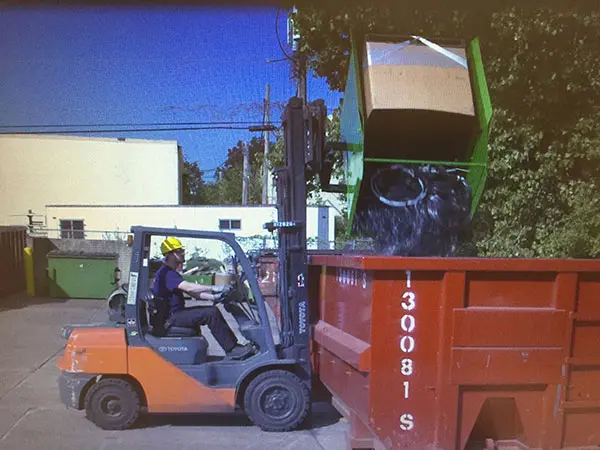
Discharging into tight, narrow spaces, such as small chutes, can result in material drop-out. Self-dumping hoppers require extra space to swing and release the load, which limits how well they can operate in low-clearance areas. Rotator boxes are smaller and can be designed in different sizes to fit your discharge area, ensuring that as much material as possible reaches the target area.
How Much Material Are You Handling?
Rotator boxes have limited weight capacity because they require manual rotation. Roura’s boxes can handle up to 6,500 lbs per load, whereas our self-dumping hoppers can handle capacities as high as 10,000 lbs.
When volume and weight capacity are key to meeting your production goals, stick to the self-dumping hopper design.
Recommended Self-Dumping Hopper Applications
- Collecting heavy scrap and waste products, such as lead, slag, glass waste, and stone ballast.
- Containing sawdust and scrap wood before disposal.
- Hauling dense construction materials, including bricks, concrete, and steel cutoffs.
- Moving heavy landscaping materials, including dirt, gravel, and landscaping stones.
- Transferring bulky agricultural products from the field to transport containers.
Recommended Rotator Box Applications
- Handling near-zero or zero dumping applications for flour and pharmaceutical powders.
- Smaller scrap metal applications.
- Unloading delicate agricultural products.
- Adding fine particles or sticky materials to hoppers that feed blenders and mixers
- Sorting lighter bulk materials for reclaim and recycling.
- Smaller waste applications.
Still Need Help? Contact Our Experts
Roura Material Handling has been designing custom hoppers and rotator boxes since our founding in 1915. We offer a variety of unique designs, including Skeleton for sheet metal and Dewatering for handling wet organic materials, and can modify each model based on your application requirements.
If you have questions about our products or need help selecting the best model for your application, contact us online or by phone at (586) 790-6100.